
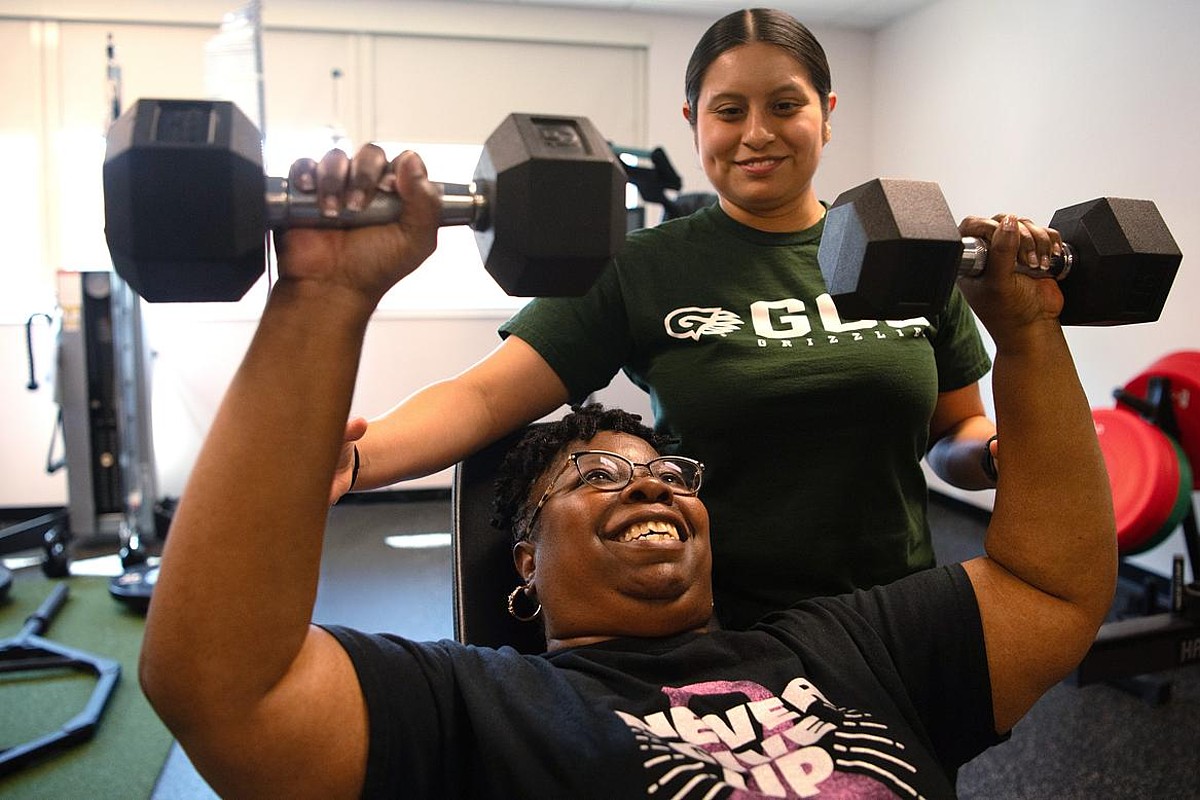
When Zulaykha Lemus-Vasquez arrives for her sessions each week, she’s not just leading exercises — she’s guiding people toward a healthier life.
A senior at Georgia Gwinnett College (GGC), Lemus-Vasquez works one-on-one with her client, helping improve strength, posture and confidence through a personalized fitness plan.
Her client, Laura Taylor, said the experience has been transformative. “I needed to get back into being active. This program has been a great boost. She has helped me with my posture and my core. I hear her in my head telling me to tighten my core and breathe from my chest. I’m even sharing what I’ve learned with my husband.”
“Laura is getting stronger and doing great,” says Zulaykha. “It’s important to meet clients where they are, understand their goals and help them set realistic expectations. I dug deep and did research on how to best support her. She’s always the first one here.”
Lemus-Vasquez is one of several students participating in a free, 10-week fitness program at GGC that pairs exercise science majors with community members. Twice a week, campus spaces are transformed into active training environments where students apply classroom knowledge in real-world settings.
Volunteers receive comprehensive fitness assessments — including blood pressure, body composition, cardiovascular fitness, muscular strength, balance and flexibility — along with customized training plans. In return, students gain valuable hands-on experience.
According to Dr. Lauren Tapp, associate professor of exercise science, the program is designed to benefit both groups. “From the first day to now, I see my students’ comfort level and confidence grow,” she said. “Their clinical skills increase, but just as important, they’re improving their soft skills.”
The program has been offered six times and has served about 40 community members, with plans to expand its reach.
For Emanuel Lizarralde, the experience has been equally impactful. “This is my first time working with a client,” he said. “The social aspect has been my biggest adjustment because I’m more of an introvert and English is my second language. But this has helped me better express myself.”
Lizarralde, who will graduate next month, said his path to exercise science was not always clear. “Originally, I was studying business, but many of my friends are physical therapists, athletic trainers and personal trainers,” he said. “I played soccer in high school, so I’ve always had an interest in these careers.”
For both students, the program represents more than academic training — it’s preparation for the future.
Lemus-Vasquez is set to begin physical therapy school just days before graduating May 15, while Lizarralde said the program has influenced his life beyond the classroom.
“The idea of fitness and better nutrition is new to my family,” he says. “Now we all understand the importance of exercise and nutrition. It’s something I’ve worked on personally because I want to take care of myself and set an example for my family and future clients.
PCOM has nearly $3 million economic impact on state
Philadelphia College of Osteopathic Medicine (PCOM) has contributed approximately $292.6 million in direct economic impact in Georgia in 2025, according to a recent report. Boosting business activity, job creation, and state and local tax revenues across the state, PCOM Georgia and PCOM South Georgia are driving forces in medical education in the state, supporting over 2,100 jobs and generating over $14 million in tax revenue statewide.
 The independent analysis, conducted by the consulting firm, Tripp Umbach, measured the growth driven by PCOM Georgia and PCOM South Georgia’s teaching, research, workforce development, community partnerships, and outreach programs across the state.
Jay S. Feldstein, president and CEO of PCOM, says: “This report highlights the results of more than two decades of PCOM’s dedicated investments in Suwanee and Moultrie. Our efforts have made a meaningful impact on Georgia’s healthcare landscape, and these findings further demonstrate the College’s critical role as an economic and community asset for Georgia.”
The economic activity stimulated by PCOM’s operations in Georgia benefited communities across the entire state, contributing to $292.6 million in economic activity in fiscal year 2025. This total reflects the direct impact of spending by both campuses ($113.7 million) and the indirect impact from vendor and supplier re-spending ($178.9 million).
Since its founding in 2005, PCOM Georgia in Suwanee has become a key educational, clinical, and economic hub for Gwinnett County and the surrounding metro Atlanta region. In 2025, PCOM Georgia generated $219.5 million in economic impact, supported 1,580 jobs and generated a total of $10.6 million in state and local taxes.
Located in Moultrie, PCOM South Georgia contributed $73.1 million to the local economy in 2025 — a sizable figure for an institution that is only five years old. Last year, PCOM’s Moultrie campus supported a total of 526 jobs and generated $3.5 million in state and local taxes.
In the academic year 2025-2026, the DO class size in South Georgia expanded to accommodate 90 students, underscoring PCOM’s sustained commitment to Georgia’s rural physician workforce. That impact is already proving significant for PCOM South Georgia as the campus achieved a 99 percent postgraduate placement rate in 2025.
The report goes on to highlight that 60 percent of DO students enrolled in PCOM Georgia and PCOM South Georgia are Georgia residents, and over half of the College’s graduates pursue primary care specialties such as family medicine, internal medicine and pediatrics. The study also found that PCOM graduates who remain in Georgia, many of whom serve in rural and medically underserved communities, contribute significantly to the state’s economy and healthcare system. The report specifically indicates that each DO practitioner generates an estimated $2.2 million in annual economic impact, supports an estimated 17 jobs, and contributes about $100,000 in state and local taxes for Georgia.
Michael Parkerson, chief government and external relations officer at PCOM, says: “We see every day how hard our students and faculty work to strengthen the communities we serve in Georgia, and we wanted to be able to quantify that. This report is a testament to the investment PCOM has made in Georgia over the past 25 years and the meaningful contributions we’ve made to the health, well-being, and economy of the state.”
