
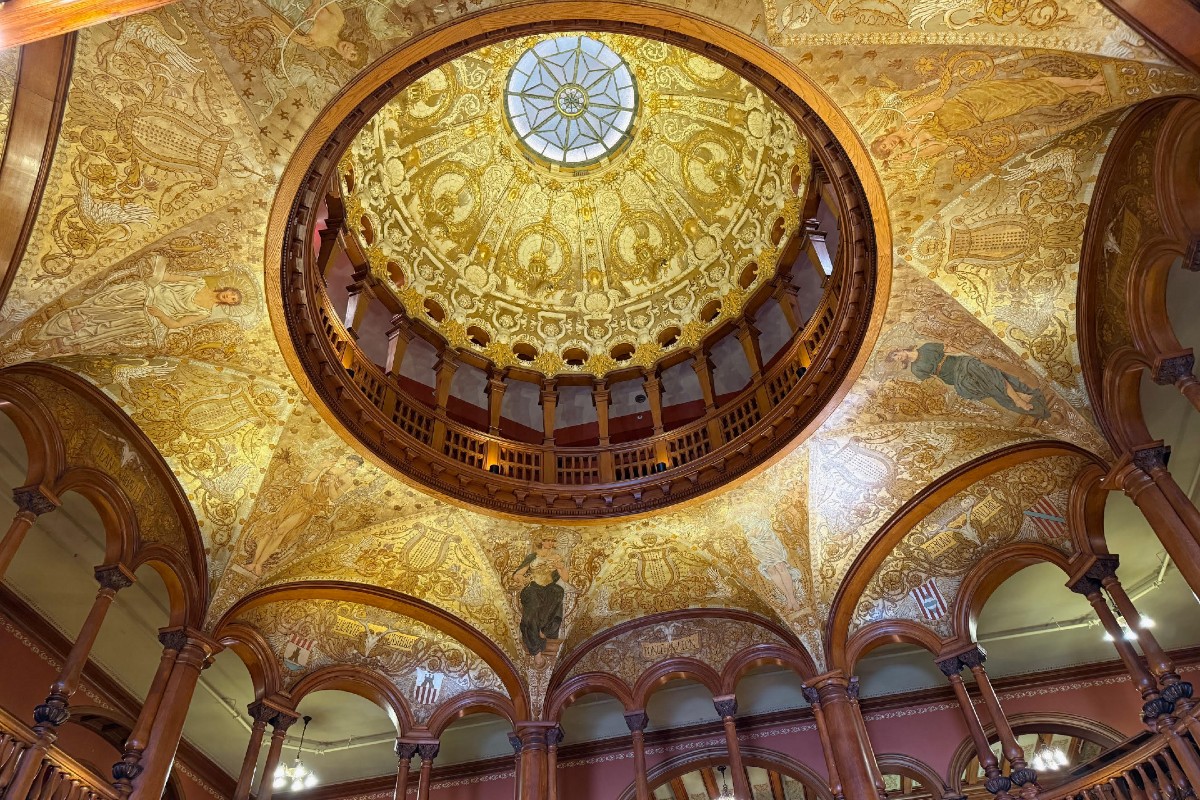
Isn’t this a beautiful dome? The dark wood and the lighter layers of color contrast neatly. Your job is to figure out where this masterpiece is located. Send your answer to ebrack2@gmail.com and include your hometown.
Today’s mystery photo is the work of Bruce Johnson of Lawrenceville.
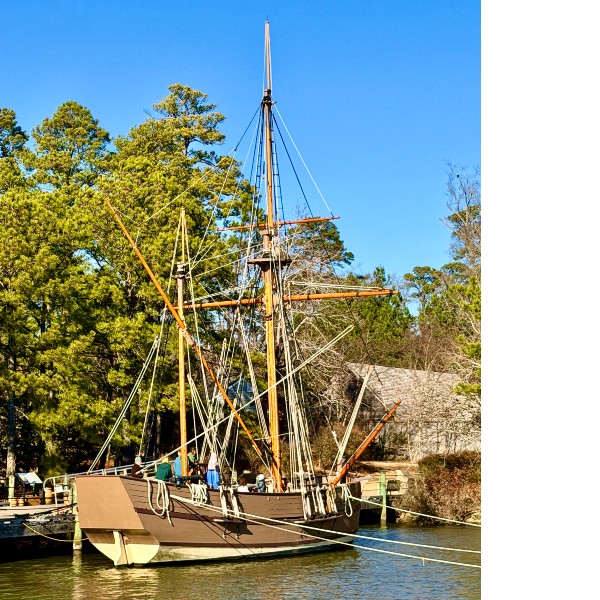 Several readers recognized our last issue’s mystery photo, including David Will, Lilburn; George Graf, Palmyra, Va.; Molly Titus, Peachtree Corners; Susan McBrayer, Sugar Hill; Jay Altman, Columbia, S.C.; Byron Gilbert of Duluth; and Allan Peel of San Antonio, Texas. He wrote:
“Today’s mystery photo is of the Discovery, a full-scale replica of a 17th-century ship, one of three that are docked at the Jamestown Settlement, a living history museum of the original 1607 European settlement in Williamsburg, Va. Named Susan Constant, Godspeed, and Discovery, three replica ships were originally created in 1956 to celebrate the 350th-anniversary ‘Jamestown Festival.’ The ships were replaced with more detailed and historically accurate replicas between 2004 and 2007 and are now docked along the James River in the Jamestown Settlement.
“The Discovery was a single-mast, 66-foot-long ship with a cargo capacity of 20 tons. It was the smallest of the three ships that took the 4-1/2-month journey from Blackwall, London, to James Forte (later called Jamestown), the first permanent English settlement in North America. It was manned by nine crew members and transported 12 colonists on the long and perilous journey. In contrast, the mid-sized Godspeed was a three-mast, 40-ton, 88-foot ship, with 13 crew members and 39 colonists, while the Susan Constant was the largest of the three ships (120-ton, 116 feet, three masts, 17 crew, 54 colonists) and served as the flagship of the fleet.
“Historically, the Discovery’s purpose was unique in that, unlike its counterparts that returned to England with timber in June 1607, the Discovery was a much smaller, faster, and more easily maneuverable ship that remained in North America and became the colonists’ primary tool for exploring the inland waterways and charting the Chesapeake Bay. Later, it famously participated in six expeditions to the Northwest Passage, including Captain Henry Hudson’s ill-fated 1610 voyage, which resulted in the 1611 mutiny. The crew became dissatisfied with Hudson’s leadership during a brutal winter when the Discovery became trapped in the ice of Hudson Bay. This eventually led to the crew mutiny in June 1611, who abandoned Hudson, his son, and seven others adrift in a small boat while the ship sailed the Discovery back to England.”
- Share a Mystery Photo: If you have a photo that you believe will stump readers, send it along (but make sure to tell us what it is because it may stump us too!) Click here to send an email and please mark it as a photo submission. Thanks.
